
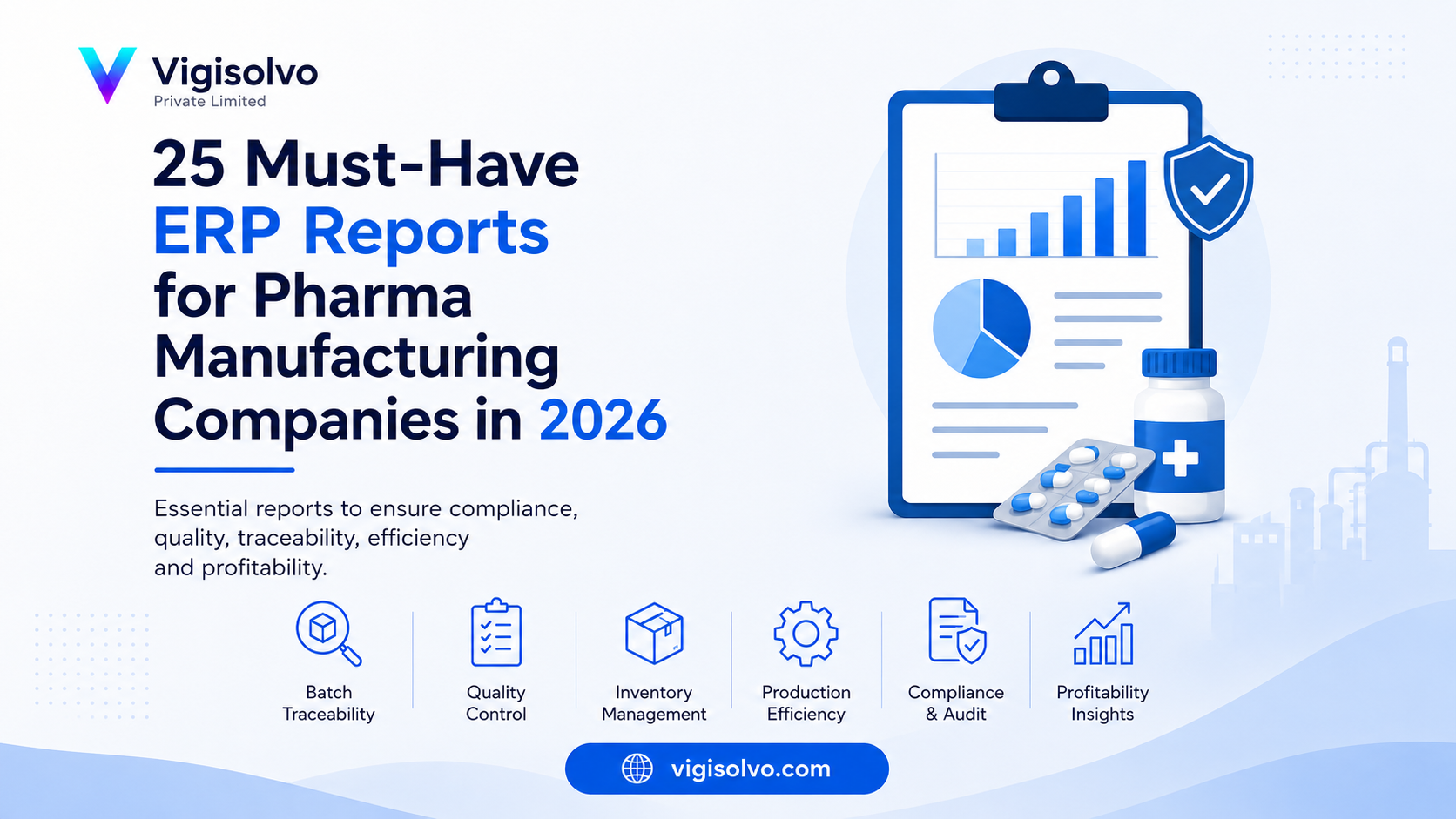
Must-Have ERP Reports for Pharma Manufacturing Companies in 2026
Pharma manufacturing in 2026 is no longer just about producing medicines on time. Companies now need complete visibility over quality, compliance, batch traceability, inventory, production cost, expiry, recalls, and audit readiness.
With stricter GMP expectations, revised Schedule M compliance pressure in India, and increasing focus on data integrity, pharma companies cannot depend only on Excel sheets, manual registers, and disconnected software. As of 2026, Indian drug regulators continue to push stricter compliance with revised Schedule M, and many MSME pharma manufacturers are still working toward meeting the updated manufacturing norms.
This is where ERP reports become very important. A good ERP system should not only record transactions but also give management, QA, production, stores, purchase, sales, and finance teams the right reports at the right time.
Below are the must-have ERP reports every pharma manufacturing company should implement in 2026.
1. Batch Manufacturing Report
The Batch Manufacturing Report is one of the most important reports for any pharma manufacturer. It gives a complete view of each batch produced, including raw material used, production stages, yield, wastage, QC status, and final output.
This report should show:
-
Batch number
-
Product manufactured
-
Manufacturing date
-
Expiry date
-
Raw materials consumed
-
Standard quantity vs actual quantity
-
Yield percentage
-
Process loss or wastage
-
Workstation or production line used
-
Operator details
-
QC approval status
-
Batch release status
In regulated pharma environments, batch records are critical because production and control records must be reviewed and approved by the quality unit. FDA guidance also highlights the importance of reviewing production and control records, including audit trails, as part of CGMP data integrity expectations.
2. Batch Traceability Report
A pharma company must be able to answer one question very quickly:
“Which raw material batch was used in which finished goods batch, and to which customer was it sold?”
The Batch Traceability Report helps track the complete journey from raw material purchase to finished goods sale.
This report should include:
-
Supplier batch number
-
Internal batch number
-
Raw material inward details
-
QC result of raw material
-
Batch in which material was consumed
-
Finished goods batch number
-
Stock movement history
-
Customer invoice details
-
Dispatch details
This report becomes extremely useful during product recalls, customer complaints, audit inspections, and internal investigations.
3. Expiry and Near-Expiry Stock Report
Pharma products and raw materials are expiry-sensitive. If expiry is not tracked properly, companies may face financial loss, compliance issues, and customer complaints.
The Expiry and Near-Expiry Stock Report should show:
-
Item name
-
Batch number
-
Manufacturing date
-
Expiry date
-
Balance quantity
-
Warehouse
-
Days left for expiry
-
Stock value
-
Status: active, near expiry, expired
This report should be available for raw materials, packing materials, intermediates, and finished goods.
A practical ERP should allow filters such as:
-
Expiring in 30 days
-
Expiring in 60 days
-
Expiring in 90 days
-
Already expired
-
Warehouse-wise expiry stock
-
Product-wise expiry stock
This helps the company plan sales, production, returns, and write-offs in advance.
4. Quarantine Stock Report
In pharma manufacturing, material should not be directly used after purchase. Usually, raw material first goes to a quarantine warehouse and can be used only after QC approval.
The Quarantine Stock Report should show:
-
Material received
-
Supplier name
-
Purchase receipt number
-
Batch number
-
Quantity received
-
Date of receipt
-
QC sample status
-
QC approval or rejection status
-
Pending days in quarantine
-
Released quantity
-
Rejected quantity
This report is very important for QA, purchase, and stores teams. It helps ensure that unapproved material is not consumed in production.
5. Quality Control Test Report
The Quality Control Test Report gives visibility into all QC tests performed on raw materials, packing materials, intermediates, and finished goods.
This report should include:
-
Sample ID
-
Item name
-
Batch number
-
Test template
-
Test parameters
-
Standard value
-
Actual result
-
Pass or fail status
-
Tested by
-
Approved by
-
Testing date
-
Remarks
For example, in an ayurvedic, nutraceutical, or pharma manufacturing company, QC reports may include tests like appearance, pH, moisture, assay, microbial limit, weight variation, hardness, friability, and disintegration, depending on the product type.
This report helps in faster batch release and better audit preparation.
6. Batch Release Report
A batch should not be sold until it is approved by the quality team. The Batch Release Report shows which batches are pending, approved, rejected, or blocked.
This report should show:
-
Finished goods batch number
-
Product name
-
Production completion date
-
QC completion date
-
QA approval date
-
Release status
-
Released by
-
Reason for hold or rejection
-
Quantity released
-
Quantity blocked
This report is especially useful for QA heads and production managers because it connects production completion with commercial dispatch readiness.
7. Deviation and Non-Conformance Report
In pharma manufacturing, deviations and non-conformances must be tracked properly. Whenever actual production, quality, or process results differ from the approved standard, the company should record and review it.
This report should include:
-
Deviation number
-
Batch number
-
Product name
-
Department
-
Deviation type
-
Description
-
Root cause
-
Corrective action
-
Preventive action
-
Responsible person
-
Closure date
-
Status
This report helps the company identify recurring quality issues and improve process control.
8. CAPA Report
CAPA stands for Corrective and Preventive Action. It is one of the most important quality management reports in pharma.
The CAPA Report should show:
-
CAPA number
-
Source of CAPA
-
Related deviation, complaint, audit, or failure
-
Root cause
-
Corrective action
-
Preventive action
-
Responsible person
-
Target closure date
-
Actual closure date
-
Effectiveness check
-
Open or closed status
A strong CAPA report helps management understand whether quality issues are actually being solved or only documented.
9. Product Recall Readiness Report
Product recall is a serious situation for any pharma manufacturer. The ERP should be able to quickly identify affected batches, customers, invoices, and stock locations.
The Product Recall Readiness Report should show:
-
Finished goods batch number
-
Customers supplied
-
Invoice numbers
-
Dispatch dates
-
Quantity sold
-
Quantity returned
-
Quantity still in warehouse
-
Distributor or stockist details
-
Linked raw material batches
This report can save significant time during regulatory or customer-driven recalls.
10. Inventory Valuation Report
Inventory is one of the biggest assets in pharma manufacturing. Raw materials, packing materials, intermediates, and finished goods must be valued correctly.
The Inventory Valuation Report should show:
-
Item-wise stock quantity
-
Batch-wise stock
-
Warehouse-wise stock
-
Stock value
-
Valuation rate
-
Stock ageing
-
Expiry status
-
Slow-moving stock
-
Non-moving stock
This report is useful for finance, stores, purchase, and management teams.
11. Slow-Moving and Non-Moving Stock Report
Pharma companies often block money in raw materials and finished goods that are not moving. This can create expiry losses and cash flow pressure.
This report should show:
-
Item name
-
Batch number
-
Last movement date
-
Current stock
-
Stock value
-
Days since last movement
-
Expiry date
-
Recommended action
This helps management decide whether to consume, transfer, discount, return, or write off stock.
12. Production Plan vs Actual Report
The Production Plan vs Actual Report helps compare planned production with actual production.
This report should include:
-
Product name
-
Planned batch quantity
-
Actual batch quantity
-
Planned start date
-
Actual start date
-
Planned completion date
-
Actual completion date
-
Delay reason
-
Yield difference
-
Production efficiency
This report helps production heads improve planning, reduce delays, and identify bottlenecks.
Recent research in pharmaceutical production scheduling also highlights the importance of data-driven planning, resource calendars, machine constraints, maintenance schedules, and cleaning time while building realistic production plans.
13. Yield Analysis Report
Yield is a very important KPI in pharma manufacturing. Even small differences in yield can create major financial impact over multiple batches.
The Yield Analysis Report should show:
-
Standard yield
-
Actual yield
-
Input quantity
-
Output quantity
-
Process loss
-
Rejection quantity
-
Batch-wise yield percentage
-
Product-wise yield trend
-
Reason for yield variation
This report helps identify production inefficiencies, raw material quality issues, machine issues, and process gaps.
14. Bill of Material Variance Report
The BOM Variance Report compares standard raw material consumption with actual consumption.
This report should include:
-
Product name
-
Batch number
-
Standard BOM quantity
-
Actual consumed quantity
-
Difference quantity
-
Difference value
-
Percentage variance
-
Reason for variance
This report is useful for production costing, quality investigation, and inventory control.
15. Cost of Production Report
Many pharma companies do not have clear visibility into actual product cost. The Cost of Production Report helps calculate the real manufacturing cost of each batch or product.
This report should include:
-
Raw material cost
-
Packing material cost
-
Labour cost
-
Machine cost
-
Overhead cost
-
QC cost
-
Rejection cost
-
Total batch cost
-
Cost per unit
-
Standard cost vs actual cost
This report helps management decide product pricing, profitability, and cost control.
16. Purchase Pending Report
The Purchase Pending Report helps the purchase team track what needs to be ordered, what is already ordered, and what is still pending.
This report should show:
-
Material requirement
-
Purchase order quantity
-
Received quantity
-
Pending quantity
-
Supplier name
-
Expected delivery date
-
Delay days
-
Linked production plan
This report helps avoid production stoppage due to raw material shortage.
17. Supplier Performance Report
Supplier quality and delivery performance directly affect pharma production.
The Supplier Performance Report should include:
-
Supplier name
-
Material supplied
-
On-time delivery percentage
-
Rejection percentage
-
QC failure count
-
Average delay days
-
Price comparison
-
Complaint count
-
Approved vendor status
This helps purchase and QA teams identify reliable suppliers and reduce quality risk.
18. Sales and Dispatch Report
The Sales and Dispatch Report gives visibility into finished goods movement.
This report should show:
-
Customer name
-
Product name
-
Batch number
-
Quantity sold
-
Invoice number
-
Dispatch date
-
Transporter details
-
E-way bill details, if applicable
-
Pending dispatch quantity
This report is important for sales, logistics, finance, and recall traceability.
19. Customer Complaint Report
Customer complaints must be recorded and investigated properly in pharma.
This report should include:
-
Complaint number
-
Customer name
-
Product name
-
Batch number
-
Complaint type
-
Complaint date
-
Investigation status
-
Root cause
-
CAPA reference
-
Closure date
This report helps QA teams identify repeated issues and maintain compliance.
20. Audit Trail Report
In 2026, audit trail reporting is no longer optional for serious pharma manufacturers. Companies need visibility into who created, edited, approved, cancelled, or changed important records.
The Audit Trail Report should show:
-
User name
-
Document type
-
Document number
-
Field changed
-
Old value
-
New value
-
Date and time
-
Reason for change
-
Approval status
Audit trail expectations are strongly linked with data integrity. 21 CFR Part 11 guidance commonly expects secure, computer-generated, time-stamped audit trails for regulated electronic records.
21. User Access and Permission Report
A pharma ERP should clearly show who has access to what.
The User Access and Permission Report should include:
-
User name
-
Role
-
Department
-
Documents accessible
-
Create, edit, delete, submit, cancel rights
-
Last login
-
Inactive users
-
Admin users
-
Permission changes
This is important because uncontrolled access can create compliance and data integrity risks.
22. Document Approval Pending Report
Pharma companies work with multiple approvals: purchase approval, QC approval, batch release approval, deviation approval, CAPA approval, and invoice approval.
The Document Approval Pending Report should show:
-
Document type
-
Document number
-
Current approval stage
-
Pending with
-
Pending since
-
Ageing
-
Priority
-
Remarks
This report helps reduce delays and improves accountability.
23. Finance and Profitability Report
Apart from compliance, pharma companies also need strong financial visibility.
Important finance reports include:
-
Product-wise profitability
-
Batch-wise profitability
-
Customer-wise outstanding
-
Supplier payable ageing
-
Cash flow report
-
GST report
-
Purchase tax report
-
Sales tax report
-
Expense report
-
Cost center-wise profit and loss
These reports help management understand which products, customers, and business lines are actually profitable.
24. Regulatory and Compliance Dashboard
Instead of checking multiple reports manually, pharma companies should have a compliance dashboard.
This dashboard should show:
-
Batches pending QC
-
Batches pending release
-
Open deviations
-
Open CAPA
-
Expired stock
-
Near-expiry stock
-
Quarantine stock
-
Rejected material
-
Pending approvals
-
Audit trail exceptions
-
Customer complaints pending closure
This gives senior management a real-time view of compliance health.
25. Management KPI Dashboard
A pharma ERP should also provide top-level business KPIs.
Important KPIs include:
-
Monthly production value
-
Batch success rate
-
Average yield percentage
-
Production delay percentage
-
QC rejection percentage
-
Inventory value
-
Expiry loss
-
Sales value
-
Gross margin
-
Customer complaints count
-
CAPA closure percentage
-
Supplier rejection percentage
This helps promoters, directors, and plant heads make better business decisions.
Why These Reports Matter in 2026
In 2026, pharma manufacturers need ERP reports for three major reasons:
First, compliance expectations are increasing. Revised Schedule M and global GMP expectations are pushing companies toward better documentation, quality systems, and data integrity.
Second, pharma margins are under pressure. Without proper cost, yield, inventory, and expiry reports, companies lose money without realizing where the leakage is happening.
Third, audits and customer expectations are becoming stricter. Companies must be able to quickly show batch history, QC status, approvals, audit trails, and traceability.
A modern ERP should not only manage accounts and inventory. It should help pharma companies become audit-ready, quality-driven, and profitable.
Final Thoughts
For pharma manufacturing companies, ERP reports are not just MIS reports. They are the backbone of compliance, quality control, production planning, inventory management, and profitability.
At minimum, every pharma ERP in 2026 should include reports for batch manufacturing, batch traceability, QC testing, quarantine stock, expiry stock, production planning, yield, BOM variance, CAPA, audit trail, inventory valuation, and product profitability.
Companies that implement these reports properly will have better control over compliance, lower expiry losses, faster audits, improved production efficiency, and stronger decision-making.
A well-configured ERP like ERPNext can help pharma manufacturers bring production, QA, QC, inventory, purchase, sales, accounts, and compliance into one connected system.
Insights
To properly understand the things that are prevalent in the industries, keeping up-to-date with the news is crucial. Take a look at some of our expertly created blogs, based on full-scale research and statistics on current market conditions.
What is DPR in Construction ERP? Daily Progress Report Explained
Learn what DPR means in Construction ERP and how Daily Progress Reports help construction…

Mradul Mishra
Oct. 14, 2026
What is BOQ in Construction ERP?
Learn what BOQ means in Construction ERP and how Bill of Quantities helps manage estimati…
Mradul Mishra
Oct. 14, 2026

What is RA Bill in Construction Management? Complete Guide for Contractors
Learn what RA Bill means in construction management, how Running Account Bills work, and …
Mradul Mishra
Oct. 14, 2026