
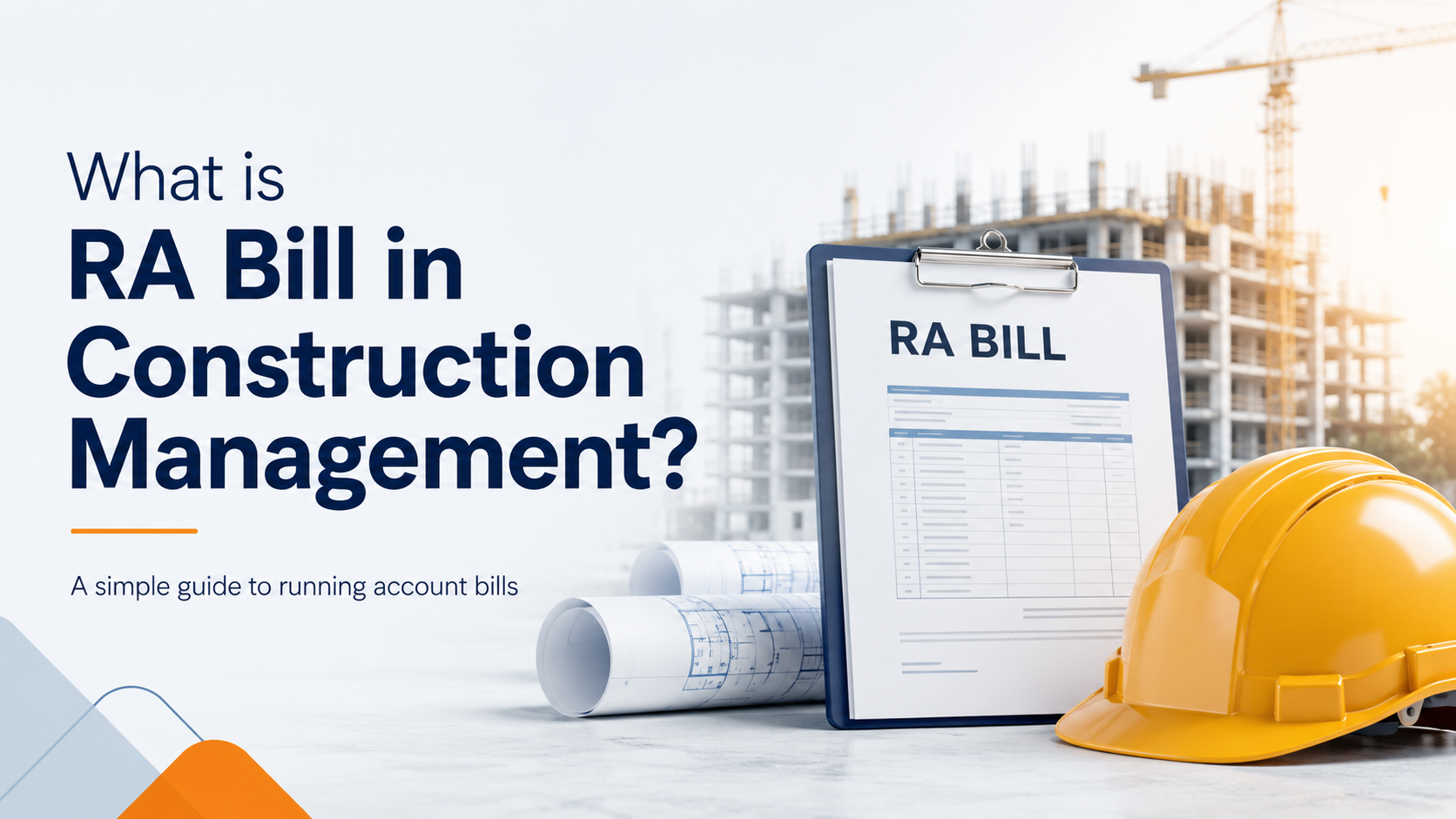
What is RA Bill in Construction Management? Complete Guide for Contractors

What is RA Bill in Construction Management?
In construction projects, payments are usually not made only at the end of the project. Since construction work continues for months or years, contractors raise bills at different stages based on the work completed.
This bill is commonly called an RA Bill, or Running Account Bill.
RA Bill is one of the most important parts of construction billing because it connects actual site work, measurement, certification, deductions, taxes, and payment.
What is RA Bill?
RA Bill stands for Running Account Bill.
It is a progressive bill raised by a contractor or subcontractor for the work completed during a specific period.
For example, if a contractor is building a residential tower, they may raise RA bills every month based on the quantity of work completed during that month.
Instead of waiting for the full project to finish, the contractor submits bills in stages.
Example:
| RA Bill | Period | Work Billed |
|---|---|---|
| RA Bill 1 | April 2026 | Foundation work |
| RA Bill 2 | May 2026 | Column and slab work |
| RA Bill 3 | June 2026 | Brickwork and plaster |
| RA Bill 4 | July 2026 | Flooring and finishing |
This helps contractors maintain cash flow and helps clients pay only for certified work.
Why RA Bill is Important in Construction
Construction projects involve large costs for material, labour, machinery, subcontractors, and site expenses. If contractors do not receive regular payments, the project may slow down due to cash flow issues.
RA billing helps in:
-
Tracking work completed
-
Certifying actual quantities
-
Managing contractor payments
-
Controlling project cash flow
-
Linking billing with BOQ
-
Avoiding overbilling
-
Tracking retention and deductions
-
Monitoring project profitability
For both client and contractor, RA billing gives a structured way to manage payments during project execution.
How RA Billing Works
RA billing usually follows this process:
BOQ → Work Execution → Measurement Entry → Quantity Certification → RA Bill Preparation → Deductions → Tax Calculation → Approval → Payment
Let us understand this step by step.
1. BOQ is Created
The project starts with a BOQ, or Bill of Quantities. BOQ contains all work items, quantities, rates, and total value.
Example:
| BOQ Item | Unit | BOQ Qty | Rate | Amount |
|---|---|---|---|---|
| RCC Work | CUM | 500 | ₹6,500 | ₹32,50,000 |
| Steel Work | KG | 80,000 | ₹62 | ₹49,60,000 |
| Brick Work | SQM | 2,000 | ₹850 | ₹17,00,000 |
RA bill is usually prepared against these BOQ items.
2. Work is Completed at Site
After work is completed at site, the site engineer or project team records how much quantity has been executed.
Example:
In May, the contractor completed:
| Work Item | Quantity Completed |
|---|---|
| RCC Work | 80 CUM |
| Steel Work | 12,000 KG |
| Brick Work | 300 SQM |
This quantity is not directly billed. It first needs to be measured and certified.
3. Measurement Book is Prepared
The Measurement Book, also called MB, records actual site measurements.
It may include:
-
BOQ item
-
Location
-
Floor
-
Block
-
Length
-
Width
-
Height
-
Number of units
-
Current measurement
-
Previous measurement
-
Cumulative measurement
-
Engineer remarks
Example:
| BOQ Item | Location | Previous Qty | Current Qty | Cumulative Qty |
|---|---|---|---|---|
| RCC Work | Tower A - 2nd Floor | 100 CUM | 80 CUM | 180 CUM |
| Steel Work | Tower A - 2nd Floor | 20,000 KG | 12,000 KG | 32,000 KG |
| Brick Work | Tower A - 1st Floor | 500 SQM | 300 SQM | 800 SQM |
The Measurement Book is the base document for RA billing.
4. Quantity is Certified
The project engineer, consultant, or client representative verifies the measurement.
There can be three quantities:
| Quantity Type | Meaning |
|---|---|
| Claimed Quantity | Quantity submitted by contractor |
| Checked Quantity | Quantity verified by engineer |
| Certified Quantity | Final approved quantity for billing |
Example:
| BOQ Item | Claimed Qty | Certified Qty | Difference |
|---|---|---|---|
| RCC Work | 85 CUM | 80 CUM | -5 CUM |
| Steel Work | 12,500 KG | 12,000 KG | -500 KG |
| Brick Work | 300 SQM | 300 SQM | 0 |
RA bill should be generated only on certified quantity.
5. RA Bill is Prepared
Once quantities are certified, the RA bill is prepared using BOQ rates.
Sample RA Bill:
| BOQ Item | Unit | Previous Qty | Current Qty | Cumulative Qty | Rate | Current Amount |
|---|---|---|---|---|---|---|
| RCC Work | CUM | 100 | 80 | 180 | ₹6,500 | ₹5,20,000 |
| Steel Work | KG | 20,000 | 12,000 | 32,000 | ₹62 | ₹7,44,000 |
| Brick Work | SQM | 500 | 300 | 800 | ₹850 | ₹2,55,000 |
Current Bill Amount: ₹15,19,000
6. Deductions are Applied
Construction RA bills usually include different deductions.
Common deductions include:
-
Retention amount
-
Mobilization advance recovery
-
Material advance recovery
-
Debit note
-
Penalty
-
TDS
-
GST TDS, if applicable
-
Labour cess, if applicable
-
Previous excess payment adjustment
Example:
| Deduction | Amount |
|---|---|
| Retention 5% | ₹75,950 |
| Mobilization Advance Recovery | ₹1,00,000 |
| TDS 1% | ₹15,190 |
| Other Deduction | ₹10,000 |
Total Deductions: ₹2,01,140
7. Tax is Calculated
GST is applied as per the applicable tax rate on construction services or works contract.
Example:
| Particular | Amount |
|---|---|
| Current Work Value | ₹15,19,000 |
| GST 18% | ₹2,73,420 |
| Gross Bill Amount | ₹17,92,420 |
| Less Deductions | ₹2,01,140 |
| Net Payable | ₹15,91,280 |
The final payable amount depends on contract terms, GST treatment, TDS, retention, and advance recovery.
8. RA Bill is Approved and Paid
After checking the RA bill, the client or project owner approves it for payment.
The approval process may include:
-
Site engineer approval
-
Project manager approval
-
Billing engineer approval
-
Consultant approval
-
Client approval
-
Accounts approval
Once approved, payment is released against the RA bill.
Types of RA Bills
1. Client RA Bill
This is raised by the main contractor to the client.
Example:
A construction company raises an RA bill to a real estate developer for completed RCC, brickwork, and plaster work.
2. Subcontractor RA Bill
This is raised by a subcontractor to the main contractor.
Example:
An electrical subcontractor raises an RA bill for completed conduit work, wiring, or panel installation.
3. Material-Based RA Bill
Sometimes billing is based on supplied or consumed material quantity.
Example:
Billing for steel fabrication, ready-mix concrete, or structural items.
4. Milestone-Based RA Bill
Some contracts follow milestone billing instead of quantity billing.
Example:
| Milestone | Billing % |
|---|---|
| Foundation Completion | 15% |
| Structure Completion | 35% |
| Brickwork Completion | 20% |
| Finishing Completion | 20% |
| Handover | 10% |
Important Components of RA Bill
A proper RA bill should include:
-
Project name
-
Client name
-
Contractor name
-
RA bill number
-
Billing period
-
Work order number
-
BOQ reference
-
Previous billed quantity
-
Current billed quantity
-
Cumulative billed quantity
-
Rate
-
Current bill amount
-
Previous bill amount
-
Total work done till date
-
Retention deduction
-
Advance recovery
-
GST
-
TDS
-
Net payable amount
-
Certification status
-
Approval details
Sample RA Bill Summary
| Particular | Amount |
|---|---|
| Total Work Done Till Date | ₹45,00,000 |
| Previous Bill Amount | ₹29,81,000 |
| Current Work Value | ₹15,19,000 |
| GST 18% | ₹2,73,420 |
| Gross Current Bill | ₹17,92,420 |
| Retention Deduction | ₹75,950 |
| Advance Recovery | ₹1,00,000 |
| TDS | ₹15,190 |
| Other Deduction | ₹10,000 |
| Net Payable | ₹15,91,280 |
Difference Between Invoice and RA Bill
Many people confuse RA Bill with a normal invoice. Both are related to billing, but they are not exactly the same.
| Point | RA Bill | Invoice |
|---|---|---|
| Purpose | To claim payment for running work completed | To legally bill for goods or services |
| Used In | Construction and project-based work | All industries |
| Based On | BOQ, measurement, certified quantity | Sales or service value |
| Frequency | Periodic during project execution | As per sale or service |
| Includes Measurement | Yes | Usually no |
| Includes Previous and Cumulative Qty | Yes | Usually no |
| Certification Required | Yes | Not always |
| Accounting Entry | After approval or billing | Direct accounting document |
In ERP, RA Bill may be used as a project billing document, and after approval it can generate a sales invoice or purchase invoice.
RA Bill vs Final Bill
RA bills are raised during the project. Final bill is raised after project completion.
| Point | RA Bill | Final Bill |
|---|---|---|
| Timing | During project execution | After project completion |
| Quantity | Partial or running quantity | Final certified quantity |
| Purpose | Interim payment | Final settlement |
| Retention | Usually deducted | May be adjusted or released later |
| Scope | Work completed till billing period | Complete project work |
Common Problems in Manual RA Billing
Many construction companies still prepare RA bills in Excel. This creates problems like:
-
Wrong previous quantity
-
Wrong cumulative quantity
-
Duplicate billing
-
Overbilling
-
Missed deductions
-
Wrong retention calculation
-
No link with BOQ
-
No link with measurement book
-
No approval workflow
-
No project profitability visibility
-
Delay in client certification
-
Difficulty tracking pending bills
These issues directly affect cash flow and profitability.
Why RA Billing Should Be Managed in ERP
A construction ERP can make RA billing more accurate and controlled.
ERP helps in:
-
Linking RA bill with BOQ
-
Auto-fetching previous billed quantity
-
Capturing current measurement
-
Calculating cumulative quantity
-
Applying approved rates
-
Managing retention
-
Recovering advances
-
Calculating taxes
-
Tracking approvals
-
Generating invoice after approval
-
Tracking payment status
-
Connecting billing with project profitability
This gives management better visibility over work done, amount billed, amount received, and project margin.
RA Billing Workflow in Construction ERP
A good ERP should follow this workflow:
Project → BOQ → Work Order → Site Execution → Measurement Book → RA Bill → Approval → Invoice → Payment → Project Profitability
For subcontractor billing, the flow can be:
Subcontractor Work Order → Work Execution → Measurement Book → Subcontractor RA Bill → Approval → Purchase Invoice → Payment
This ensures that both client billing and subcontractor billing are controlled.
Important RA Billing Reports in ERP
A construction ERP should provide the following RA billing reports:
-
RA Bill Summary
-
RA Bill Register
-
BOQ vs Billed Quantity Report
-
Previous vs Current Billing Report
-
Certified Quantity Report
-
Pending RA Bill Approval Report
-
Retention Deduction Report
-
Advance Recovery Report
-
Client Billing vs Collection Report
-
Subcontractor Billing Report
-
Project-wise Billing Report
-
Project Cash Flow Report
-
Project Profitability Report
These reports help the company monitor billing, collections, deductions, and profitability.
Example of RA Bill in Construction ERP
Suppose a contractor has a work order of ₹1 crore.
Till last month, the contractor already billed ₹30 lakh.
This month, the certified work value is ₹15 lakh.
Then the RA bill will show:
| Particular | Amount |
|---|---|
| Total Contract Value | ₹1,00,00,000 |
| Previous Bill Value | ₹30,00,000 |
| Current Bill Value | ₹15,00,000 |
| Cumulative Bill Value | ₹45,00,000 |
| Balance Work Value | ₹55,00,000 |
Now deductions may apply:
| Deduction | Amount |
|---|---|
| Retention 5% | ₹75,000 |
| Advance Recovery | ₹1,00,000 |
| TDS 1% | ₹15,000 |
After GST and deductions, the net payable amount is calculated.
This gives clear visibility of previous billing, current billing, cumulative billing, and balance work.
Benefits of RA Billing in ERP
RA billing in ERP helps construction companies:
-
Improve billing accuracy
-
Reduce manual Excel errors
-
Avoid duplicate billing
-
Track certified quantities
-
Control subcontractor payments
-
Improve cash flow
-
Track retention and advance recovery
-
Improve client billing transparency
-
Connect billing with accounting
-
Monitor project profitability in real time
Final Thoughts
RA Bill is one of the most important documents in construction management. It helps contractors claim payment for completed work during project execution and helps clients verify and pay based on certified quantities.
A proper RA billing system should always be linked with BOQ, Measurement Book, approvals, deductions, taxes, invoices, and project profitability.
For any construction company, managing RA bills manually in Excel can become risky as the number of projects, subcontractors, and BOQ items increases.
A well-implemented Construction Management ERP can make RA billing more accurate, transparent, and profitable by connecting site execution, measurement, billing, accounts, and project costing in one system.
Insights
To properly understand the things that are prevalent in the industries, keeping up-to-date with the news is crucial. Take a look at some of our expertly created blogs, based on full-scale research and statistics on current market conditions.
What is DPR in Construction ERP? Daily Progress Report Explained
Learn what DPR means in Construction ERP and how Daily Progress Reports help construction…
Mradul Mishra
Oct. 7, 2026
What is BOQ in Construction ERP?
Learn what BOQ means in Construction ERP and how Bill of Quantities helps manage estimati…
Mradul Mishra
Oct. 7, 2026
What is RA Bill in Construction Management? Complete Guide for Contractors
Learn what RA Bill means in construction management, how Running Account Bills work, and …
Mradul Mishra
Oct. 7, 2026